RPO LAST SPRINT
Finishing up on RPO
This week, I focused on finishing up on my RPO after refining on the issues which was brought up during my consultation last week. I also continued to expand my readings to see how I can better deepen my conceptual knowledge and writing.
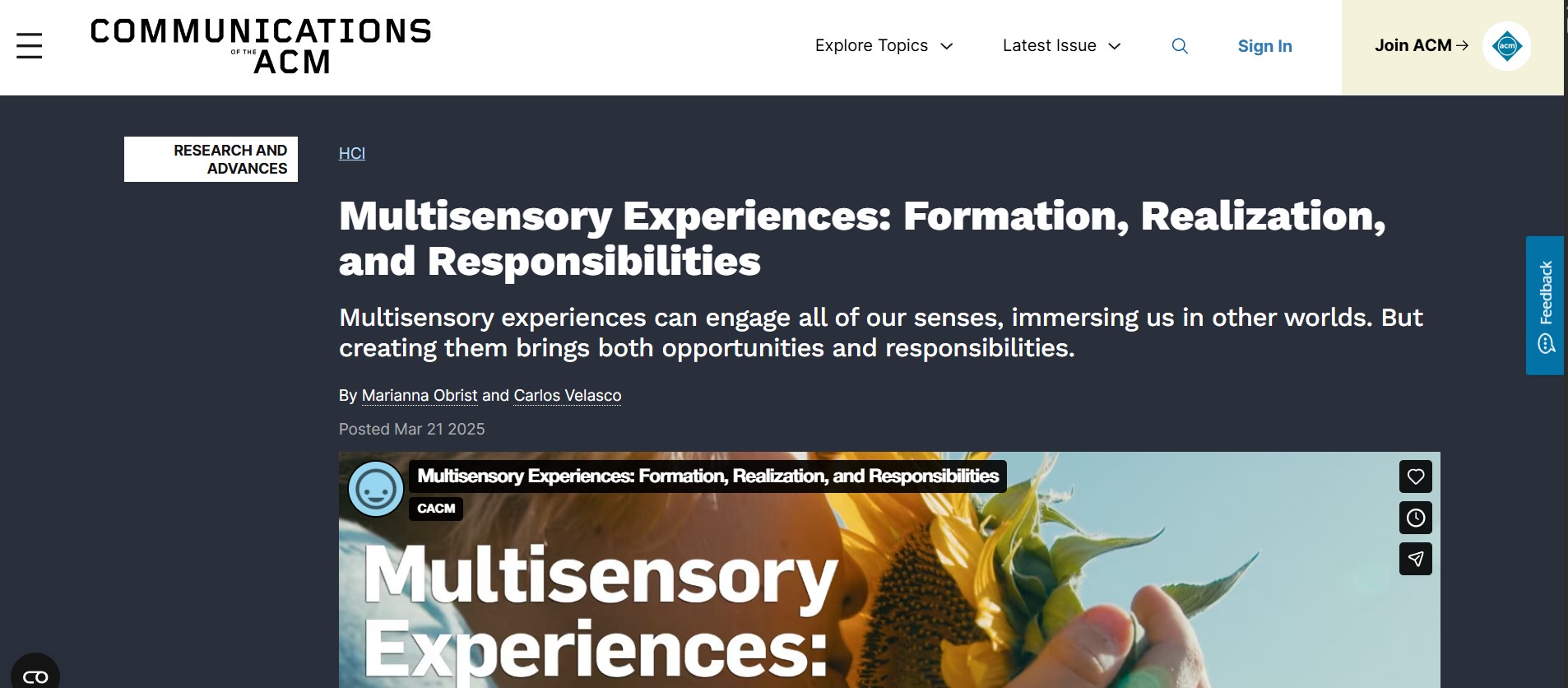
Web version of the PDF Journal Article I referred to
This research article looks into the various components that makes up a user's journey in a multisensory experience, such as how we perceive sensory stimuli and how that leads to our understanding of our environment. There are also case studies given of Multisensory Interfaces that seek to break the conventional audio-visual interface approach by looking into the novel integration of touch, taste and smell. Overall, this article is very valuable to me as it further helps me establish a stronger understanding of how humans perceive sensory stimuli and provided me some case studies to look into. Below are some learning points.
Probably one of the more important and new concepts I learnt was the concept of accounting for events that happens before and after the multisensory experience. For example looking at the experience of picking up a sunflower in a garden, our pre-encounter in walking through the garden and our post encounter after plucking up the flower can affect our overall feelings and perception of the whole experience. Thus in my own practice, I should pay attention to my audiences pre and post encounters and identify possible design interventions that can help improve their experience.
It is also important to consider the cultural background and demographic of our audiences as these past experiences can have a impact on their intepretation of their multisensory experience. For example, while the Chinese views the color Red as auspicious, Koreans might perceive it as unlucky. Thus, this reminds me the importance of understanding who my target audiences is and conduct adequate research to ensure my design interventions are perceived in the right way I envisioned it to.
A interactive tech experience that happened during the Great Exhibition Road Festival in 2019 that explores the idea of educating people on complex and abstract concepts, such as Dark Matter. Users would take a pill (popping candy) that makes them Dark Matter detectors, embarking on a sensorial narrative experience that uncovers the truth of Dark Matter. The whole experience uses all 5 senses of the human body, yet all of them were carefully designed to align with our scientific understanding of Dark Matter. This is a great case study example for me as it highlights the importance of aligning our design interventions accurately with the context that it is grounded in to provide a educational and immersive experience.
Organizing my Reading List
Over the course the past few weeks, I have compiled more readings and oraganised them within my Miroboard. I grouped them according to their relevance to the pillars that I currently have, but their references are not solely contained within the pillars but can be cross referenced with each other. Within all of these frames are individual readings with notes that I took diligently!
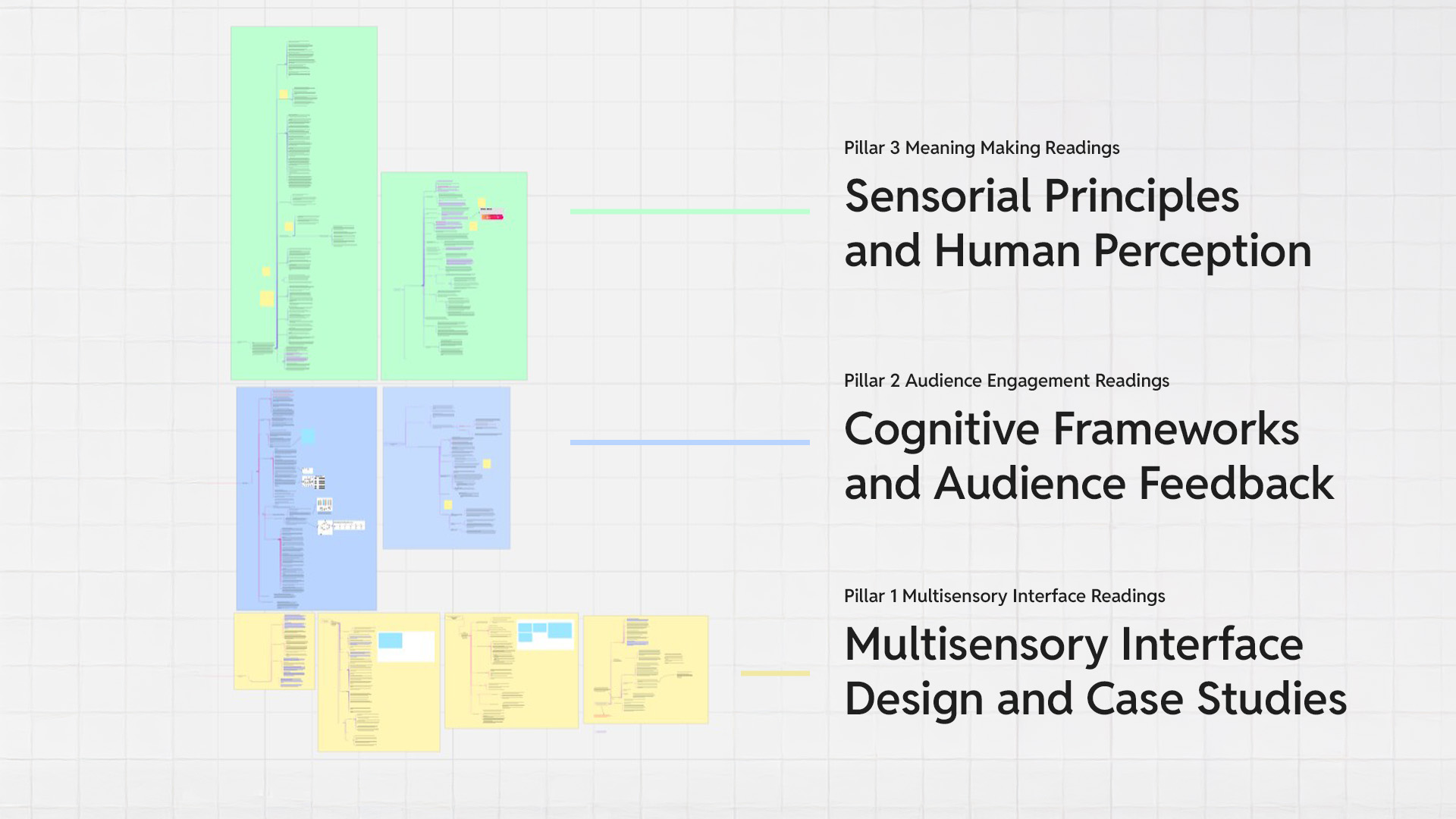
My current reading organization on Miro
A research paper that studies into the effectiveness of touch-visual interfaces and how it impacts human emotions. This paper provides me insights into how people perceive tactile experiences and how visual representations can help augment their experiences with organic matter. The paper features a case study on a Interactive Plant interface, where people can touch a plant and see their touch visualise on screen.
A previously discussed reading in this CPJ. The concept of TUI and the various sharing by different designers on their approaches towards Tangible User Interface design provides me valuable insights on how to approach my writing and designs of Multisensory Interfaces.
The reading that was just discussed above. Highlighted new possible considerations for my approach towards my writing and design, such as accounting for audience's cultural background and considering pre and post encounters.
Very valuable book in this pillar. Educates me on the cognitive frameworks that guides how we direct our attention within a multisensory experience. For example, it talks about concepts such as Facilitatory Attentional Capture, which is about how we can craft multisensory stimuli together to capture the attention of audiences. For example, a painting of a boat in a thunderstorm, accompanied with sounds of thunder and rain, can draw the attention of audiences better as the sounds compliment the visuals.
Discusses mainly on the case study of Tate Sensorium, which is a exhibition on artworks augmented with multisensorial experiences and technology. Particularly, It studies intensely on the case study of the "Full Stop Painting", which uses interactive mid-air haptics to let audiences touch the painting. This paper provides me insight on the possible impacts of integrating tactile interventions within a interface and also understand more about exhibitions in a museum context.
The first reading discussed in this CPJ. This paper establishes my foundational knowledge on perception of sensory experiences and provides me with guiding sensorial principles (I.E Congruency of Stimuli) that ultimately helps guide my making. There is also discussion on how multisensory experiences can help audiences in their understanding and perception, which is particularly relevant in this pillar. For example, they state how Congruent stimuli (I.E when we see smooth objects and we touch a smooth surface), help us understand what we are interacting with more effectively.
A book that dives into how designers should approach the design of multisensory products/interfaces. It provides valuable approaches and concepts, such as Sensory Modality Mapping, which emphasizes on the importance of mapping relevant sensory interactions within our designs (I.E If there is high pitch sound, the visual should perhaps show length or sharp characteristics).