This week was a burn out. I mean literally because my laptop CPU fan and motherboard burned up, just right before my consultation with Andreas. Hence, I was lowkey panicking the entire time during my consultation, but glad that my laptop braved through till the end for me to show my progress. Luckily for me, I extended my warranty last year, which paid off because I didn't have to pay for the servicing this time round. However I was presented with a situation: I did not have any laptop to work with now. Luckily, my girlfriend (Rene) and Carissa both offered to lend me their laptops which allowed me to continue working and not let this issue halt my progress. Big thanks to them!
While I have situated my research and making within Singapore's heritage scene, I am still left with a burning question: What specific cultural heritage are my prototypes based within? Singapore is a vibrant multi-cultural society, thus I am quite overwhelmed with options. For example, I can work with hawker culture, which is Singapore's unique community dining experience recognized by UNESCO. Or I can work with the Lion Dance culture, specific to the chinese, or even the Thaipusam festival, unique to the local indians. However, I decided that I wanted to choose a culture that includes Singaporeans as a whole, and not just a specific race. After much research, I decided that I should work on the Peranakan Culture of Singapore, which is regarded as one of the most significant heritage locally.
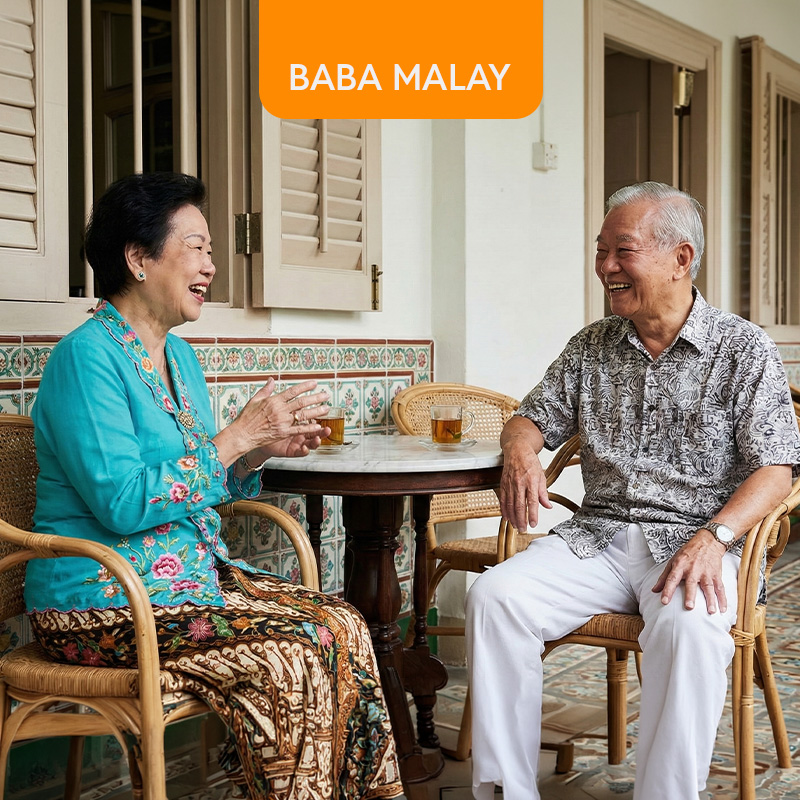
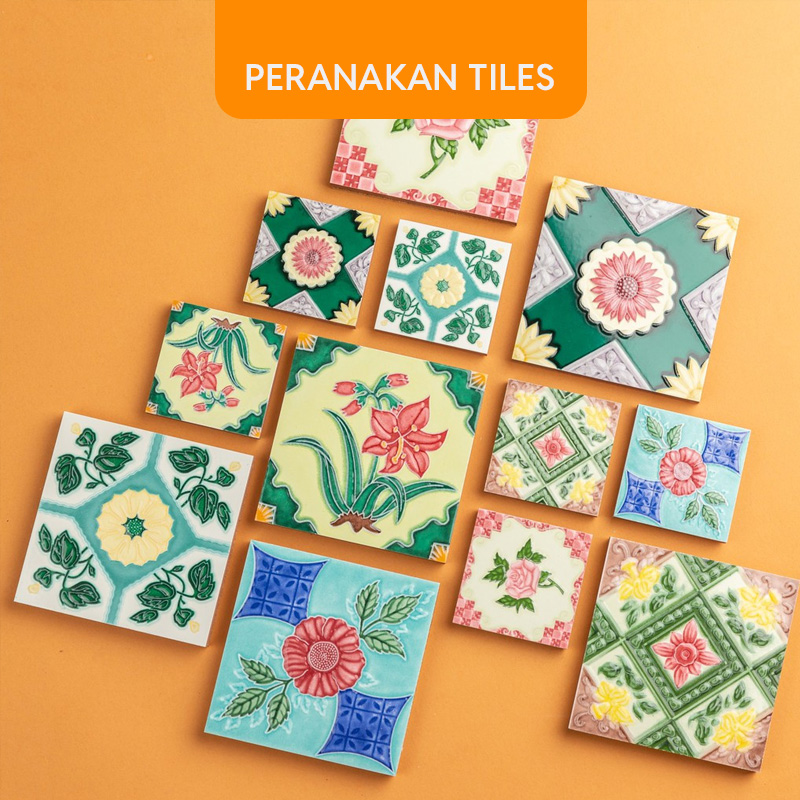
Examples of Peranakan Culture
-
-
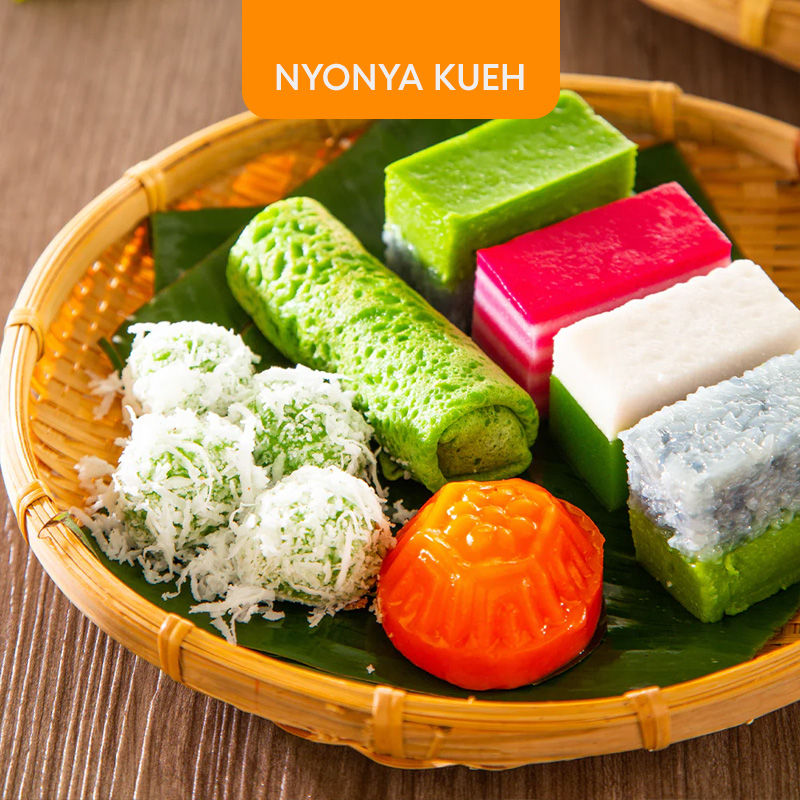
The Peranakans are a social group formed as a result of the intermarriages between foreign traders and the local people of Singapore. As a result, the Peranakan culture integrates different aspects from European, Indian, Malay and Chinese culture cohesively together, resulting in its vibrant heritage history that we know of today. The above images are some examples of the unique cultural heritage of the Peranakans, ranging from its distinct language coined as "Baba Malay", to the delicious nyonya kuehs.
Information provided by National Heritage Board, link is here.
A particular cultural practice which I was interested in was the Peranakan's use of Batu Lesong. The Batu Lesong (known as Pestle and Mortar) is a kitchen tool where nyonyas use to grind coarse ingredients into paste used for cooking. Using a Batu Lesong requires attention to pacing and strength to ensure that the ingredients are grinded smoothly. The sound of a nyonya's use of the tool also serves as a indicator of how good a cook they are.
Information provided by National Heritage Board, link is here.
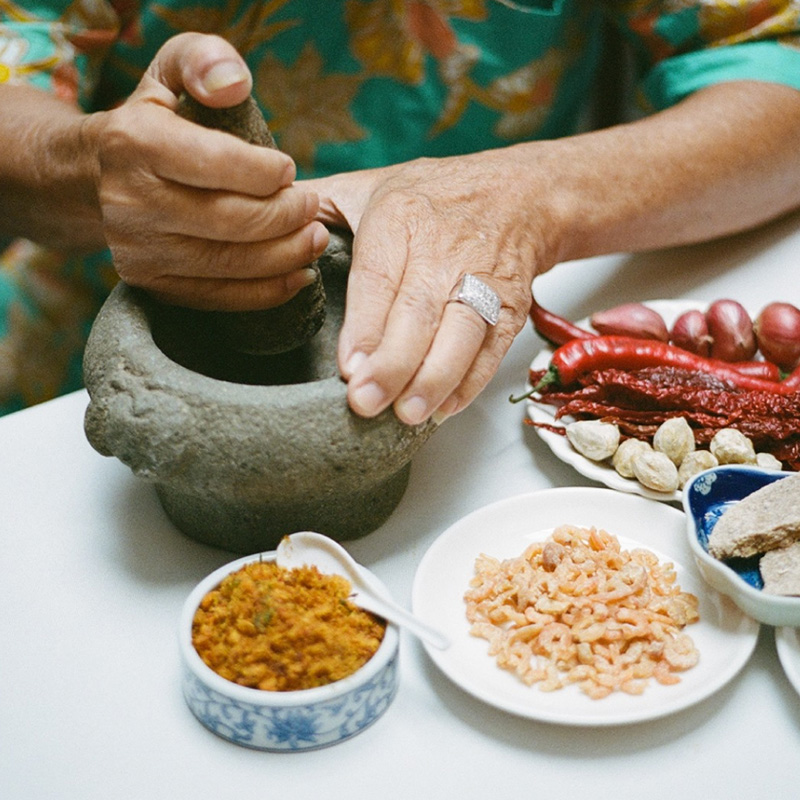
Using Batu Lesong to grind ingredients.
Inspired by the tool of Batu Lesong, I developed an idea for my first prototype of the semester. I envisioned a interaction where users can grind a digital Rempah paste (Spice Paste) on screen through their physical interaction with the Batu Lesong. In other words, the Batu Lesong becomes a Tangible User Interface where users use physical inputs to change digital data shown on screen.
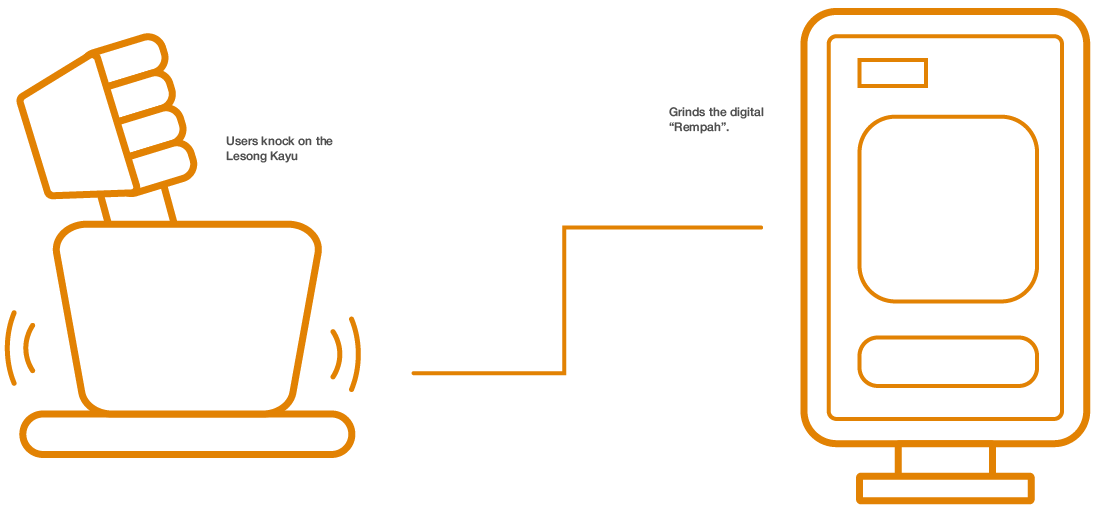
I started the making process with the creation of the digital visuals on TouchDesigner. I wanted the
visual outcome to resemble the rempah paste, thus I did this by using POP Copy instancing, which is
basically where I use small tiny cuboids, copied thousands of times and clustered together to form a
large textured blob. I added a Noise POP to distort and transform the visuals of the textured blob,
which allows me to create two different visual states: (1) Rough, clustered
state that represents the coarse ingredients before grinding, and (2) Smooth, flat state that represents that the rempah paste has been
successfully grinded. Linking back to my concept, this visual transformations serves as the foundation
of the interaction, where users grind on the physical Batu Lesong to smoothen out the digital rempah
paste from state (1) to (2).
At this point, I have yet to integrate the physical Batu Lesong
into the interface, so I just added in an audio of the knocking of the Batu Lesong to simulate the
physical interaction input first. The audio data from the knocking is extracted with CHOPS and mapped
to the Noise POP parameters to allow the data to directly transform the visual on screen.
-
The Rempah visual slowly transforming from coarse to smooth
-
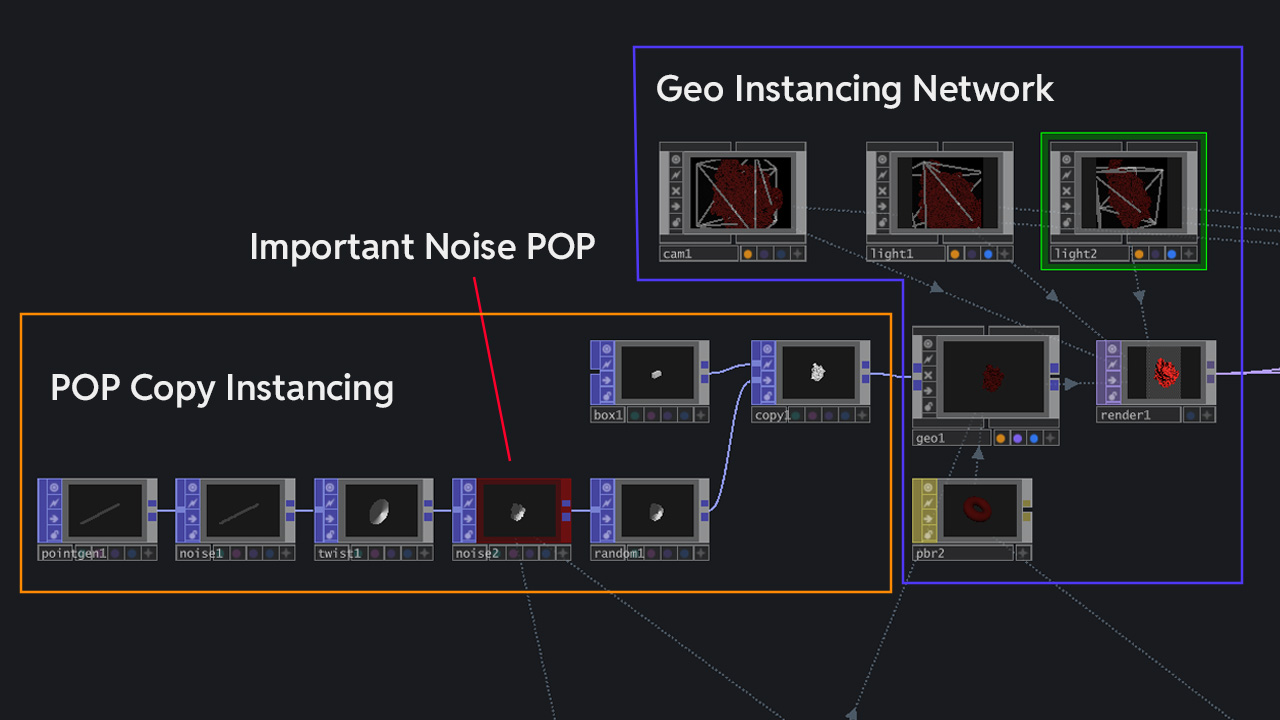
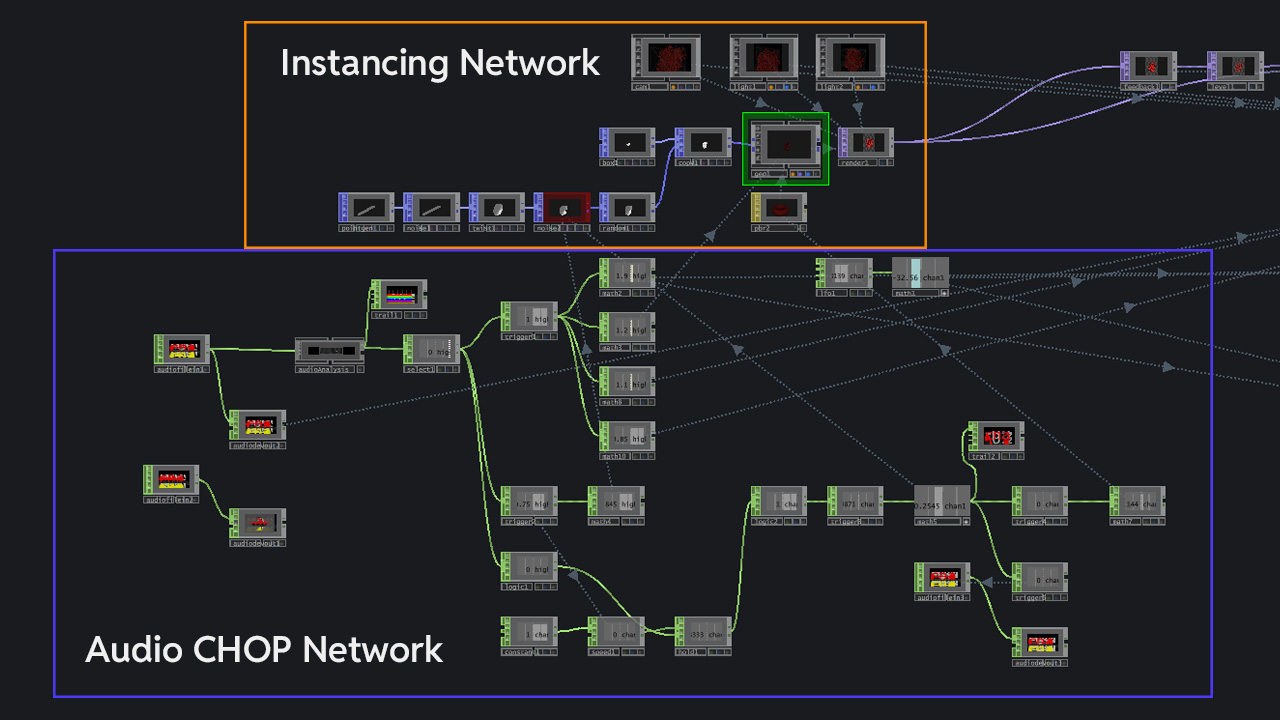
TouchDesigner Node Networks
I presented my current progress to Andreas for feedback (with my laptop burning up). Overall, the current progress still needs plenty of work in terms of user interaction feedback and overall concept. Below are the key points for improvements highlighted to me.
The overall interaction lacked a interaction feedback that rewards users for completing the experience. Thus, this didn't make the overall interaction interesting enough for users currently. This reward can be implemented through novel visual transformation or audio cues.
On a similar note to point 1, even though there was a visual feedback that reacts to user's input, it was not obvious or exciting enough. Thus, this can cause user confusion on whether their input has been successfully registered, leading to a poorer user experience.
Andreas encouraged me to start trying integrating the Batu Lesong as the physical input. This integration allows us to evaluate the whole interface better as we can assess it as a whole experience, instead of just the visuals.
To summarize, the key point to be taken here is that there is still much work to be done with regards to user interaction feedback and the implementation of the physical Batu Lesong input. I also feel that the visuals do need to be reworked as I find them not visually appealing. As such, I would look into using Particle Instancing to create the visuals instead, as using particles would allow for me to create more dynamic outcomes, which helps both in aesthetics and visual interaction feedback. Just to share, Particle Instancing is a method in TouchDesigner where we can use thousands of tiny particles to form a larger visual, similar to my current method but has a more flexible workflow due to how particles work.